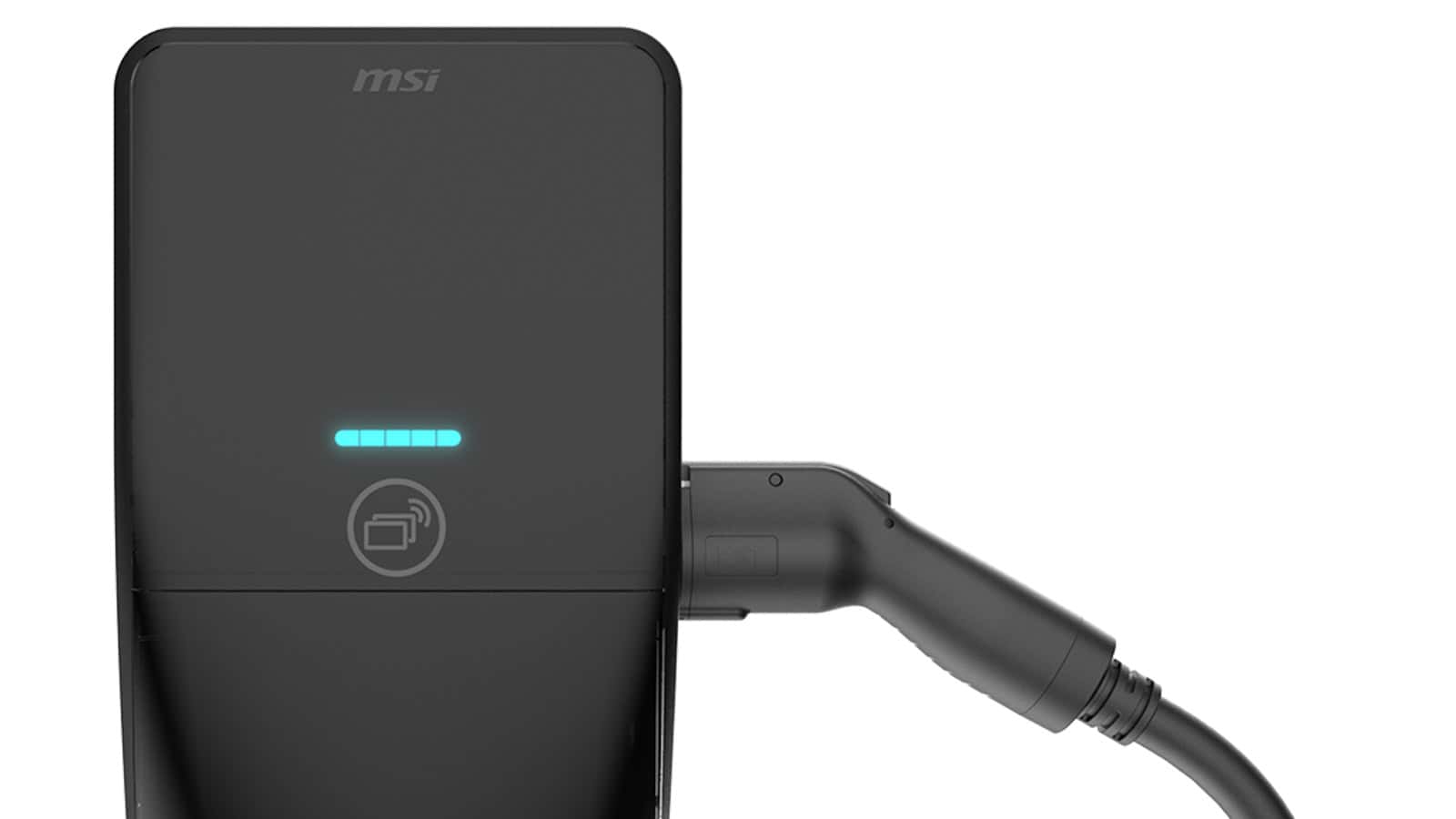
- MSI’s EV Life and EV Life Plus chargers offer up to 14.4 kW (60 A) charging power and are dual compatible with SAE J1772 and Tesla’s NACS.
- Price for the EV Life line starts at US$449.99 (hardwired), with a five-year warranty included. EV Life Plus starts around US$549.99 / plug-in US$599.99.
- These chargers are built for extremes: operating temperatures from -40°F to 131°F, with water/dust resistance (IP55 & IP67) and impact protection (IK08).
ADVERTISEMENT
Did you know an EV charger can go from “meh” to “wow” in just one product launch? That might sound dramatic. But MSI’s new EV Life and EV Life Plus chargers are making people blink. Yes, gaming-hardware legend MSI is stepping into electric vehicle charging, and it’s doing so with courage, smarts, and what I’d call serious value.
For nearly 40 years MSI has made freakishly powerful PCs, motherboards, high-end displays, workstations, you name it. Now it’s tackling EV charging. MSI has announced the EV Life and EV Life Plus, part of its EVSE (Electric Vehicle Supply Equipment) line, bringing high-performance charging to homes and business locations without draining your wallet.

Here’s what makes them stand out (yes, you will want one).
The chargers push out up to 14.4 kW at 60 amps on a 240-volt circuit, supporting both Type 1 (SAE J1772) and Tesla’s NACS connector, which means most EVs sold in the United States can plug in directly.
These chargers are built for extremes, running in temperatures from minus 40°F up to 131°F. They carry IP55 and IP67 ratings for protection against dust and water, along with IK08 impact resistance, meaning they can handle anything from heavy rain to a stray pebble.
You can go with a hardwired installation or simply plug into a NEMA 14-50 outlet. Perfect for garages, new builds, or retrofit projects. The cable stretches roughly 24.6 feet, giving you plenty of reach.
ADVERTISEMENT
The base “Life’ model includes the MSI aConnect app, which lets you schedule charging, adjust current, review usage history, and update firmware. The “Life Plus” version goes further by adding RFID authentication, Wi-Fi and Ethernet connectivity, along with support for the OCPP 1.6J protocol, a widely used standard for commercial and networked charging.
The EV Life hardwired version starts at $449.99, with the plug-in option running roughly $50 higher. The EV Life Plus begins around U$549.99 for the hardwired model and about $599.99 for the NEMA 14-50 plug-in. A five-year warranty is included with registration, making the overall value tough to ignore

“The EV market doesn’t need more of the same. It needs smarter, more resilient solutions at price points that accelerate adoption. With our EV chargers, MSI is proving that drivers no longer have to choose between quality and affordability. We see this as the first step in redefining what people should expect from charging infrastructure,” said Engin Yoruk, North America Product Manager of EVSE at MSI.
So what does all this mean for someone actually plugging in at home or work. With 14.4 kW you are adding roughly 43 to 59 miles of range every hour depending on the vehicle and conditions. That kind of output makes overnight charging truly practical, with enough energy stored to cover the next day without the stress of asking yourself in the morning, “Did I even plug in.”
ADVERTISEMENT
The environmental design makes it far less likely that snow, summer heat, or moisture will damage the unit. And since the chargers support open protocols like OCPP 1.6J and have strong connectivity, they can tie into solar setups, utility demand response programs, or even fleet management systems. That combination can translate into serious long term savings.
You will need a 240-volt circuit with enough capacity when choosing a hardwired installation, and your electrical panel must be able to handle the load if multiple chargers are connected. The plug-in versions can simplify installation, although local codes or electrician availability may restrict options. Long-term durability will still rely on how the charger is used, the surrounding environment, and proper maintenance.

Wrapping things up, MSI’s entry into EV charging has the potential to shake up pricing, add useful features for residential users, and provide a real option against established names like Tesla and ChargePoint. For anyone considering an EV charger, the EV Life and EV Life Plus deserve serious attention.
ADVERTISEMENT

SOURCE | IMAGES: MSI
FTC: We use income-earning auto affiliate links. Learn more.